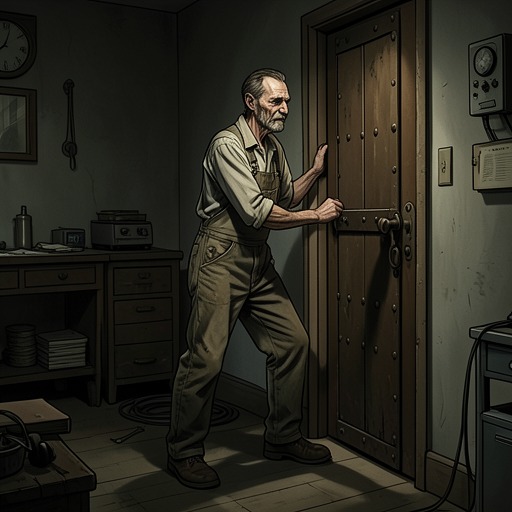
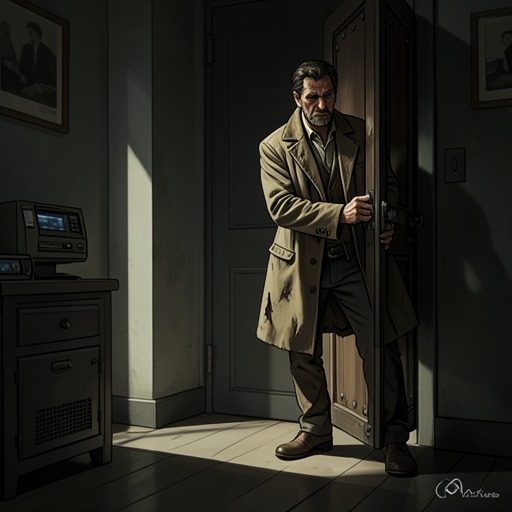
Franz Biberkopf
Berlin AlexanderplatzFranz Biberkopf, a former cement worker and furniture removal man, returns to Berlin after prison with a simple ambition: to live decently. The novel tests that ambition against the city’s economic pressures, his history of violence, and a chain of relationships that draw him back toward crime. His story ends not with a triumphant restoration of the man who left prison, but with a changed identity and a modest job.
Identity and Background
Before his imprisonment, Franz had worked as a cement worker and later as a furniture removal man. His past includes the fatal assault on Ida, a young woman who had become attached to him. After he injured her in a fight, she died in hospital several weeks later. Her death did not end his anger: she died hating him, and his fury toward her persisted after she was buried at the Landsberger Allee cemetery. The novel sets this history beside his public promise to begin again, making his proposed respectability inseparable from the violence he would prefer to leave behind.
Franz is presented as coarse and uncouth, and his determination to reform is at once sincere and overconfident. At first, the plan appears to him almost self-evident: he will simply behave decently. Yet the narrative makes that confidence part of the problem. Once his resolve is tested, he recognizes that its apparent simplicity has concealed a flaw in his understanding of himself and his circumstances. What had seemed like a plain moral choice begins to look naïve, arrogant, and weakly founded.
Release and Estrangement in Berlin
Franz’s release from Tegel penitentiary is a crisis before it becomes a freedom. After four years in prison, he stands outside the gate in a yellow summer coat while the other prisoners remain at work in the fields and workshops. He lets tram after tram pass and presses himself against the prison’s red wall. The closed gate does not immediately feel like liberation; he experiences himself as cast out, facing a world he has not yet managed to re-enter.
Eventually he boards a tram, but the movement into the city brings panic rather than ease. He gets off among strangers, tries to steady himself, and walks through busy streets and past shop windows. The crowd offers motion without belonging: people move about, yet Franz experiences the city as strangely lifeless behind its activity. At Rosenthaler Platz, where the cobbles are being torn up and pedestrians cross on wooden planks, he is physically among the crowd but remains unsettled by it. The scene establishes a recurring tension in his life: public places offer anonymity and contact, but neither guarantees security or connection.
His return to selling newspapers marks a practical re-entry into Berlin. He changes districts, leaving Rosenthaler Tor for Alexanderplatz, and appears healthier and more self-possessed: he has lost weight, carries himself better, and wears a newsvendor’s cap. The change is visible, but it does not resolve the deeper instability that the opening scenes have exposed. The novel’s attention moves between Franz’s individual path and the city around him, where crowds, commerce, and construction continue on a scale that makes his personal effort seem precarious.
The Vow Under Pressure
Franz’s vow to live decently holds while he has money. When his funds run out, the novel presents the shortage as a turning point: he has been waiting for the moment when he can prove what kind of man he is, but financial pressure instead exposes how little his resolve has prepared him for hardship. His commitment is not simply discarded at once. He struggles with the possibility of failure and becomes deeply saddened by the realization that his plan may have been defective from the beginning.
The betrayal associated with Otto Lüders sharpens that crisis. After a day spent brooding, Franz receives a letter from a woman and asks whether any other delivery has arrived, including a parcel of goods. The small exchange anticipates his retreat from ordinary business and from the people around him. When Lina comes to his room with a brown cardigan she has knitted for him, she finds him at home rather than out working. He barely looks toward her, has a hangover, and is absorbed in taking apart an alarm clock. The domestic visit gives a concrete form to his withdrawal: he does not explain himself, and even the object occupying him is being dismantled rather than put to use.
His isolation does not amount to a considered solution. Later, when he emerges from his hiding place, the memory of recent events accompanies him, and his attention fixes on the missing bottle he left behind. He hesitates over whether to return for it or go into a pub, caught between opposing impulses. The episode presents drinking not as a cure for his troubles but as part of the indecision through which he tries to escape them. His failure to find a stable answer leaves the vow intact in words but increasingly hollow in practice.
Friends, Work, and the Return to Crime
Franz’s relationships repeatedly test his loyalty and judgment. His reunion with Gottlieb Meck is exuberant and physical: the two men shake hands and arms, clap one another on the back, and greet each other with the familiarity of old companions. Meck’s welcome offers a moment of connection, but friendship does not provide Franz with a reliable shield against the pressures that follow.
A later conversation with Cilly makes his loyalty to Reinhold especially clear. Cilly regards him as naïve, while Franz insists on standing by Reinhold even when Reinhold is in trouble. He considers whether he should take Trude off Reinhold’s hands, and points to Reinhold’s supposed wish to pray at the Salvation Army meeting on Dresdener Straße as a reason to support him. Franz’s readiness to defend Reinhold shows how readily he turns friendship into an obligation, even when another person’s caution might be warranted. The narrative pairs this conviction with an image of a bird startled by a serpent: Franz is awake to danger, but not to the full extent of the threat surrounding him.
The prospect of work offered by Pums puts the same vulnerability into economic terms. Pums asks whether Franz still wants to earn a living selling newspapers and proposes that he manage a fruit or vegetable barrow supplied by the gang. Franz is tempted by the promised profit but distrusts Pums’s associates and fears being cheated. Reinhold remains silent in the background while Franz looks to him for an opinion. The exchange makes the choice less a clean decision between honest labor and crime than a pressured negotiation between the need to earn, mistrust of the gang, and dependence on a friend whose judgment Franz continues to seek.
The larger movement is nevertheless toward criminal involvement. Franz has sworn to live decently and manages it for a period, but the narrative describes that interval as only a stay of sentence. He resists being drawn into crime, yet is overwhelmed and participates. The change reverses his earlier public commitment: he returns to the very world from which he had meant to separate himself, not through one triumphant choice but through an accumulation of need, pressure, and compromised loyalties.
Injury, Loss, and a Changed Return
Franz’s involvement in the criminal world culminates in a severe physical change. Found unconscious on a road, he is taken by car to Magdeburg, where doctors operate that night and amputate his right arm at the shoulder. The other injuries initially described are considered less serious, though the possibility of internal injury remains uncertain. The loss of his arm alters the conditions under which he can work and move through the world; it also makes the body itself a lasting record of the violence that has overtaken his attempted reform.
The news of Mieze’s murder compounds that loss. Franz sees a newspaper page with two photographs: one shows him, the other Reinhold, beside a headline reporting the murder of a woman near Freienwalde. The victim is identified as Emilie Parsunke from Bernau, the woman Franz knows as Mieze. His recognition connects the public report to his private life and to Reinhold, while the newspaper that once represented Franz’s livelihood becomes the means by which he confronts the murder. The revelation leaves him to face both Mieze’s death and his own proximity to the events surrounding it.
After his arrest, Franz is brought in handcuffed and questioned. He hangs his head, remains frozen, and does not speak; his right eye is swollen from a blow with a rubber truncheon, and he suddenly drops his injured arm. The scene closes off the possibility that he will explain himself through an ordinary account of events. Silence, physical vulnerability, and arrest replace the self-assurance with which he once announced his plan to reform.
Transformation and Narrative Role
The novel’s account of Franz’s collapse and recovery divides his identity sharply. At one point the man who dies is named as a former transport worker, burglar, pimp, and killer. Another man then lies in the bed: he has Franz’s identity papers and resembles him, but in another world bears another name. The narrative subsequently calls the returning figure Franz Karl Biberkopf, distinguishing him from the first man and recalling that Karl was given to him as a second name after his maternal grandfather.
This changed Franz returns to Berlin by way of Stettiner Bahnhof. The city is no longer experienced as a structure about to move or as a place from which he must seek shelter in dark courtyards. He walks along Invalidenstraße and Ackerstraße toward Brunnenstraße, passing the yellow market hall, and looks calmly at the streets, shops, houses, and people. The return echoes his first passage through Berlin, but reverses its emotional charge: the familiar city remains, while the man moving through it has changed.
Immediately after Reinhold’s trial, Franz accepts part-time work as a doorman in a medium-sized factory. The ending is deliberately restrained. No further account of his life follows, and the job does not erase his past or turn the earlier vow into a simple success story. Franz’s arc instead makes the cost of his attempted self-reinvention visible: his idea of decency fails under pressure, his return to crime brings irreversible consequences, and his eventual return to ordinary life belongs to a different self. The novel follows him through episodic encounters with work, friendship, the street, and the law, using his precarious position in Berlin to expose the distance between wanting a decent life and being able to secure one.